

 William Cope
 Pinakini Shah
 Nadia Ayub
 Miquel Colobran
.png "Samuel Chukwuemeka Obasi") Samuel Chukwuemeka Obasi
Samuel Chukwuemeka Obasi Sara Richter
Learning, Knowledge and Human Development MOOC’s Updates
Update #1 - IQ Tests: example, use and going beyond
IQ TEST EXAMPLE
I checked out an online IQ Test for 12-year-olds [1] (see test below). It included 15 questions. I tried it out and will disclose that my score of 125 meant that there are a 5 % or so of 12-year-olds who do better than me at the test.
The test seams used for evaluating verbal understanding, mathematical logic and visual recognition and processing.
Most questions felt easy for me, a couple hard (e.g., 5, 6 and 11) and the rest ambiguous. For example, on question 7, is the horse much bigger than the other animals or is the cat most likely to stay in your home? On question 8, is the cabbage the only vegetable versus fruits, or is the banana the only non-round object?
IQ TESTING
Humans can learn, but only within the parameters of what their intelligence is and intelligence is variable. Intelligence test, called Intelligence Quotient tests (IQ tests), measure just that. Alfred Binet is the founder of the idea of mental age and Henry Goddard then created the idea of an IQ and the mathematics of calculating IQ scores [2].
IQ tests measure mental abilities, with the distinction of knowledge (acquired), versus intelligence (inborn), according to Goddard. Intelligence is the potentiality of the machine. Knowledge is the raw material upon which it works., the other acquired. Intelligence is the potentiality of the machine.
I understand that Goddard’s wish is to facilitate the use of the intelligence of people who own it for the good of the entire society and in particular in favor of those who do not own it. An illustrative argument of Goddard is the extreme example of a person who is a ‘walking encyclopedia’ but who makes almost no use of her/his knowledge because she or he does not have the natural intelligence.
In a nutshell, IQ tests are used to identify people who are supposed to be more intelligent, in terms of logic and memorization.
But this view taken by itself is dangerous because it boxes individuals in an overly simplistic way and prevents from seeing additional human factors.
BEYOND IQ TESTS
One first factor is human personality. What is the use of a hyper-intelligent person if the person does not make efforts to exploit their intelligence or uses their intelligence for goals that do not serve the ‘good’ (as for example in its definitions by utilitarist philosopher Jeremy Bentham or by philosopher Immanuel Kant)?
A second factor is the increased understanding that intelligence can be learnt. “Researchers in neuroplasticity now contend that the concept of a ‘hard-wired’ brain—one fixed and unchanging in its makeup—is inaccurate.” [3] Such findings go hand-in-hand with the understanding of computer machine learning. Learning of the billions and trillions of neurons is not just the storing of data (knowledge), but also the building of data processing schemes (intelligence) that are learnt over time. The human brain can be analogized to a neural network machine [4], with similar learning and reinforcement mechanisms, including rewards consisting of short- and long-term optimization of fitting patterns with actual data.
As a third factor, just like with a neuron machine, the human intelligence and knowledge learning depends on which situation and data the human is exposed to and exposes her/himself to. This is where human agency comes in. Carol Dweck’s growth mindset [5] encompasses the extent to which this impacts education and personal development. When students believe they can get smarter, they understand that effort makes them stronger. They then put in extra time and effort, and it translates into better learning.
ONLINE TEST [1]
1) Which number logically follows the series: 3, 7,12,18, 25, 33, 42…?
48, 50, 52, 54
2) What will be the next number in: 32,16,8,4,2,…?
4, 3, 2, 1
3) What is the value of d, when ABCD= 3257 and abcd=214…?
6, 5, 4, 3
4) There are 25 books on the table, and you took ten. How many do you have?
35, 25, 15, 10
5) Which one of the letters does not belong in the following series: A.C.F.J.O.?
S, T, U, X
6) Which word logically follows this series: Eat,Boat,Water, Jacket, puzzle, …?
Accept, Acrobat, Actually, Activity
7) Which one of the four is least like the other three?
Horse, Cat, Chicken, Bird
8) Which one of the four is least like the other three?
Banana, Cabbage, Cherry, Peach
9) AVACADO=5756592 AVAC=5756 VADO=…?
6592, 9257, 7592, 5659
10) Which one of the four is least like the other three?
Cat, Dog, Bird, Bus
11) Which one of the letters does not belong in the following series: Z.X.U.Q.L?
K, I, H, F
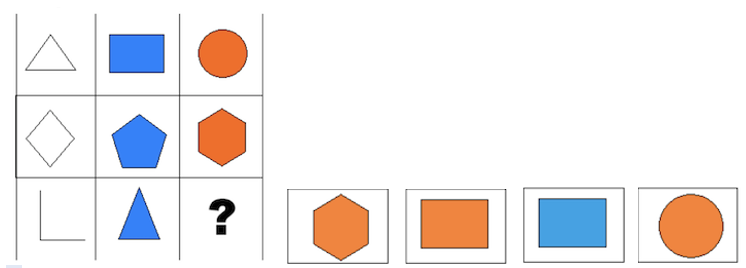
12) What should the missing shape be?
13) Which shape completes the pattern?

14) Which shape completes the pattern?
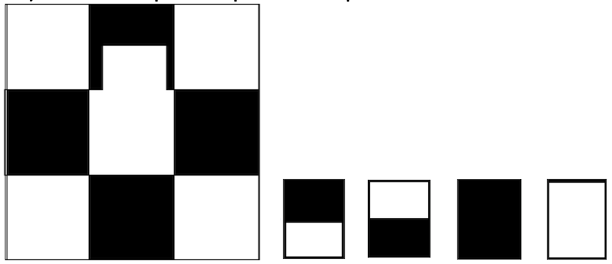
15) What should the missing shape be?

REFERENCES
[2] https://newlearningonline.com/new-learning/chapter-6/supporting-material/goddard-on-iq
[3] Forbes - Always Learning, Always Growing: How Neural Networks Do The Hard Work (Jul 17, 2018) https://www.forbes.com/sites/insights-intelai/2018/07/17/always-learning-always-growing-how-neural-networks-do-the-hard-work/?sh=2d4049c3156b
[4] Simplilearn - Neural Network In 5 Minutes (Jun 19,2019) https://www.youtube.com/watch?v=bfmFfD2RIcg
[5] Carol Dweck - What Having a “Growth Mindset” Actually Means (Jan 13, 2016) https://hbr.org/2016/01/what-having-a-growth-mindset-actually-means


